
Blog Article
1900 Dracena’s NOI increased nearly 20% after its 2022 sale, yet its 2026 asking price is lower. The comparison shows how current buyer math affects value.

Stay Updated on Exclusive Opportunities & Off-Market Deals
A Los Angeles apartment building valuation is not determined by income alone.
Since KST sold 1900 Dracena Dr. in 2022, the property’s stated gross operating income has increased approx. 15% and its stated net operating income has increased nearly 20%. Yet, as of August 24, 2026, the same building is being offered at $3,225,000, approx. 10% below its $3,600,000 sale price.
An asking price is not a closed sale, and one building does not define the entire market. But this comparison is useful because the asset is the same. It shows how a higher NOI can be offset when buyers apply a higher going-in return and a lower income multiple.
For owners still comparing today’s value with a 2021 or 2022 sale, that distinction matters. Improving operations can strengthen a property without returning it to its prior value if the market is pricing the income differently.
The Same Los Feliz Building at Two Different Points in the Market
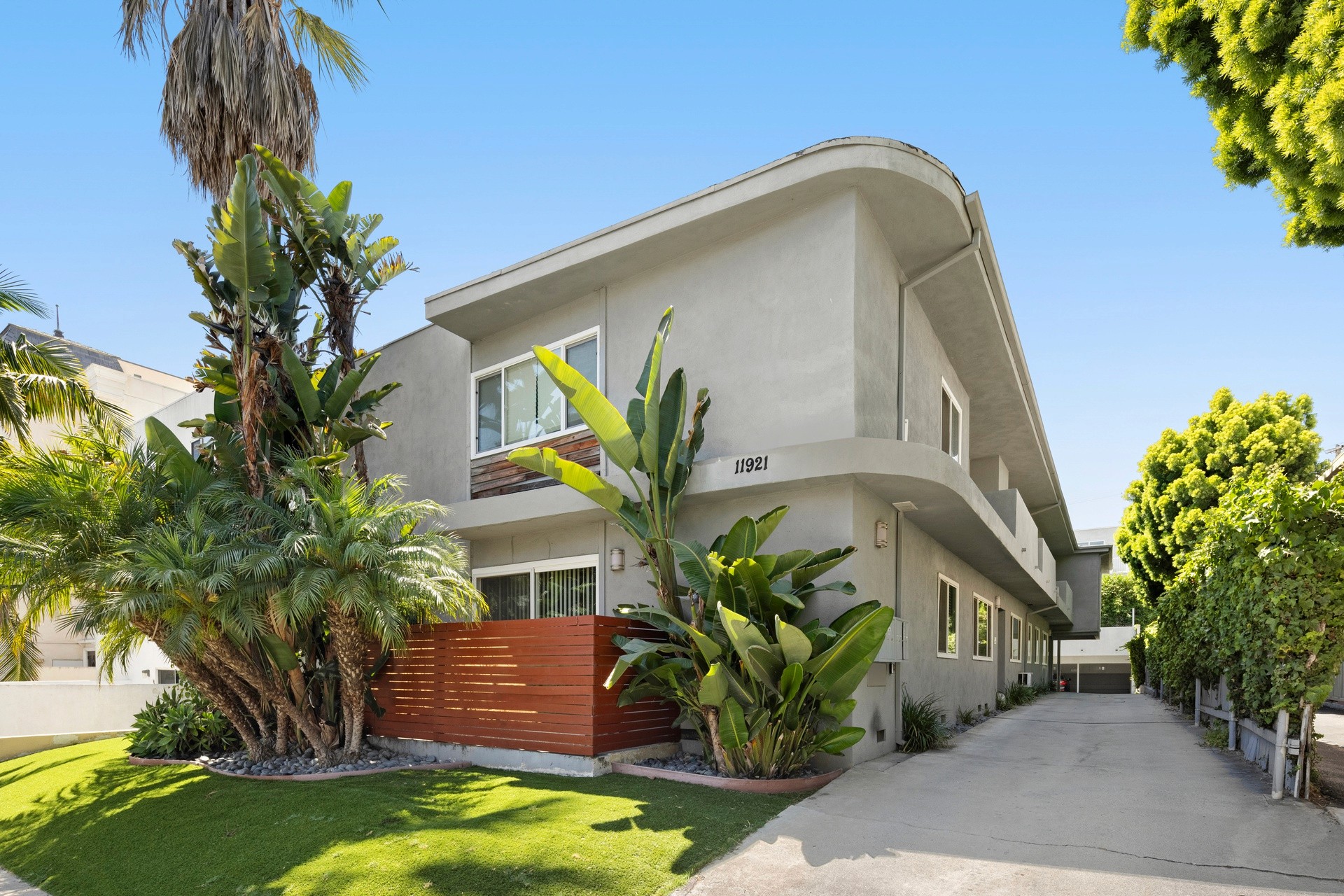
1900 Dracena is an 8-unit apartment building at Dracena Dr. and Franklin Ave., approx. 2 blocks west of Hillhurst Ave. Built in 1965, the property contains 6 two-bedroom, two-bath units and 2 one-bedroom, one-bath units across 7,442 SF.
KST brought the property to market in 2022 and opened escrow approx. one month after signing the listing agreement. The transaction worked through several due diligence issues and ultimately closed for $3,600,000.
The property returned to the market in July 2026. The current public offering identifies an asking price of $3,225,000, or $403,125 per unit and $433 per SF, with a stated 5.60% CAP.
The following comparison uses KST’s 2022 sale records and the financial information presented in the current offering. For consistency, the 2022 CAP below is calculated directly from the stated $150,505 NOI and $3,600,000 sale price.
Metric | 2022 Closed Sale | 2026 Current Offering | Change |
|---|---|---|---|
Price | $3,600,000 | $3,225,000 asking price | -10.4% |
Gross operating income | $229,370 | $263,193 | +14.7% |
Operating expenses | $78,865 | $82,660 | +4.8% |
NOI | $150,505 | $180,533 | +20.0% |
CAP | 4.18% implied | 5.60% offered | +142 basis points |
GRM | 15.70 | 12.25 | -3.45 |
PPU | $450,000 | $403,125 | -10.4% |
PPSF | $483 | $433 | -10.4% |
The income increased. The asking price decreased. The reason becomes clearer when the valuation math is separated into its components.
How CAP Rates Affect Apartment Building Value
The income approach begins with a simple relationship:
Property value = NOI ÷ market CAP
NOI represents the property’s income after operating expenses but before debt service, depreciation, and income taxes. The market capitalization rate, or CAP, reflects the return buyers require for that income based on the property, location, condition, regulation, available financing, and competing investment options.
In 2022, the stated $150,505 NOI divided by the $3,600,000 sale price produces an implied 4.18% CAP.
In the current offering, the stated $180,533 NOI divided by the $3,225,000 asking price produces an implied 5.60% CAP.
That 142-basis-point difference is enough to outweigh the property’s 20% increase in NOI.
The impact can be seen by applying different CAP assumptions to the current NOI:
CAP Applied to $180,533 NOI | Indicated Value |
4.25% | $4,248,000 |
4.50% | $4,012,000 |
5.00% | $3,611,000 |
5.50% | $3,282,000 |
5.60% | $3,224,000 |
6.00% | $3,009,000 |
These are mathematical illustrations, not value conclusions. A market CAP has to be supported by recent closed sales, current buyer requirements, and the property’s specific risk profile. The table shows why a small change in the rate can move value by hundreds of thousands of dollars even when the income is unchanged.
GRM Tells the Same Story From a Different Direction
GRM measures price relative to gross income:
GRM = Property price ÷ annual gross income
It is a quick comparison tool because it does not require a full expense analysis. That simplicity is also its limitation. GRM cannot show whether one building has higher insurance, utilities, repairs, management costs, or property taxes than another.
At the 2022 sale, 1900 Dracena traded at a 15.70 GRM. The current offering is positioned at 12.25 GRM.
The property’s gross income increased approx. 15%, but the multiple applied to that income contracted approx. 22%. Multiplying a higher income by a materially lower market multiple can still produce a lower value.
This is why owners should not evaluate progress only by comparing the current rent roll with the one they had several years ago. The income may be better while the market’s price for each dollar of income has changed.
Why Buyers May Require More Return Today
A CAP is not selected in isolation. It is the result of how buyers compare the property’s income with its risks, financing, capital needs, and available alternatives.
Debt and competing returns affect the price buyers can support
Financing does not appear in the CAP formula, but it affects the offers buyers can make. A buyer still needs the property’s income to support debt service and the required return on invested equity.
CBRE’s H1 2026 U.S. Cap Rate Survey reported that the 10-year Treasury yield was near 4.6% in mid-July and that uncertainty around interest rates continued to affect commercial real estate investment activity. CBRE also emphasized that CAP ranges vary with location, quality, and property-specific characteristics.
When debt is more expensive and other investments offer more yield, a buyer may need a higher return from an apartment acquisition. The seller may have improved the building, but the buyer’s capital still has to work under current conditions.
Buyers underwrite future expenses, not only historical expenses
The seller’s operating statement is the starting point, not always the buyer’s final NOI.
A buyer may adjust property taxes, insurance, management, vacancy, repairs, utilities, and reserves to reflect the expected cost of ownership after closing. In California, a qualifying change in ownership generally causes the county assessor to reassess the property at its current fair market value, subject to applicable exclusions. The California State Board of Equalization explains that this reassessment can increase or decrease property taxes depending on the new value relative to the existing assessed value.
That matters when a long-time owner’s actual tax expense is materially below what a buyer expects after acquisition. The owner may be producing one NOI, while the buyer is using a different normalized NOI to decide what the property is worth.
The path to future rent growth affects what buyers pay today
Future upside still matters, but buyers do not value every dollar of projected rent equally.
They consider how long the increase may take, what improvements are required, whether units must turn over, and which regulations apply. The Los Angeles Housing Department states that the City’s RSO generally covers rental properties first built on or before October 1, 1978, along with certain replacement units. Owners and buyers should use the LAHD RSO property search to confirm an individual property’s status.
A projected market rent is not the same as collected income. The time, cost, and legal path required to reach it affect how much a buyer will pay for that upside now.
The Seller’s NOI and the Buyer’s NOI May Be Different
One of the most important parts of a Los Angeles apartment building valuation is deciding which income and expenses should be capitalized.
An owner may calculate NOI using the property’s actual collections and paid expenses. A buyer may normalize those figures based on how the building is expected to operate after the acquisition.
Common adjustments include:
Recalculating property taxes at the anticipated acquisition value
Replacing the existing insurance cost with a current quote
Adding professional management, even when the seller self-manages
Applying a vacancy and credit-loss assumption
Normalizing repairs and maintenance across more than one year
Separating recurring operating costs from capital improvements
Verifying laundry, parking, utility reimbursement, storage, and other income
Removing income that is temporary, uncollected, or unsupported by tenant records
These adjustments do not mean the seller’s records are wrong. They reflect the buyer’s expected cost of owning the property.
This is also why an unusually low expense ratio may not increase value as much as an owner expects. Buyers will ask whether the expenses are sustainable, whether necessary work has been deferred, and whether the property has been managed at a level they can reproduce.
A Credible Valuation Uses More Than One Metric
CAP and GRM are important, but neither should determine value by itself.
A complete Los Angeles apartment building valuation should reconcile several views of the property.
This article focuses primarily on apartment buildings with 5 or more units. Duplexes, triplexes, and fourplexes can be influenced more heavily by residential financing, owner-user demand, and comparable home sales. KST’s guide to Los Angeles duplex, triplex, and fourplex investment explains those differences.
Income approach
The income approach compares a supportable NOI with a market CAP. It is especially important for 5+ unit properties because buyers are acquiring an income stream, not only the underlying real estate.
GRM
GRM provides a quick comparison between price and gross income. It is useful when the properties have similar expense structures, but it can mislead when taxes, insurance, utilities, condition, or management costs differ materially.
Comparable sales
Recent closed sales help establish how buyers are pricing similar buildings. The comparison should account for location, unit count, unit mix, building size, age, condition, parking, rent-control status, current income, and future capital needs.
PPU and PPSF can be useful checks, but they do not explain the income supporting the price. A lower PPSF building may still be expensive if the income is weak. A higher PPU may be justified by larger units, updated systems, stronger current income, or a different regulatory profile.
Current buyer response
An analysis based only on historical sales can lag a changing market. Active buyer feedback, recent tours, offers, lender terms, and properties that failed to sell can show where the market is moving before the next comparable sale closes.
KST’s broader Los Angeles multifamily market 2026 review discusses how buyers are weighing current income, basis, expenses, financing, building condition, and the time required to capture future upside. The Los Angeles multifamily pricing reset provides a second same-property example involving a newer Sherman Oaks asset.
What 1900 Dracena Means for Los Angeles Apartment Owners
1900 Dracena does not show that improving income is unimportant. The opposite is true.
The current NOI is approx. $30,000 higher than it was at the 2022 sale. Holding everything else equal, that additional income would support more value. But everything else is not equal.
The return applied to the income changed. The GRM changed. Financing changed. Buyer expectations changed. The asking price reflects those differences, even though the property is generating more income.
For owners, there are several practical takeaways.
Income growth should be measured against the current market
Increasing rents, improving collections, adding other income, and controlling expenses can all strengthen value. The result still needs to be capitalized at a rate buyers will accept today.
Peak-era sales are historical evidence, not current value conclusions
A 2021 or 2022 sale can remain relevant, especially when it involves the same building. It still needs to be adjusted for income, expenses, condition, financing, regulations, and current buyer return requirements.
Asking prices and closed prices are different evidence
The current $3,225,000 figure is an asking price. It shows how the property is positioned, not where it will close. The eventual sale, if one occurs, will provide the stronger market evidence.
Renovation and rent growth should be evaluated against their cost
An owner should not assume that every dollar spent on improvements will be recovered at sale. The relevant question is how the work affects collected income, operating costs, buyer risk, and the market return applied to the building.
How Owners Can Prepare for a Current Valuation
Before relying on an online estimate, an old appraisal, or a peak-market comparable, owners should organize the information buyers will actually underwrite.
1. Reconcile the rent roll with the bank deposits and tenant files
Confirm current rent, concessions, deposits, move-in dates, parking, laundry, utility reimbursements, and any informal agreements. A rent roll that cannot be supported will receive less credit from buyers.
2. Review at least 12 months of operating expenses
Separate recurring operating costs from capital work. Identify unusual expenses, unpaid bills, insurance changes, utility increases, and repairs that may not appear every year.
3. Calculate both actual and buyer-normalized NOI
An actual NOI explains current performance. A normalized NOI shows how a buyer may evaluate the building after adjusting taxes, insurance, management, vacancy, repairs, and other expenses.
4. Separate current value from stabilized value
If the property has rental upside, calculate what it supports today and what it may support after the required time and capital. Do not present stabilized income as though it is already being collected.
5. Compare recent closed sales before active listings
Active listings show current seller expectations. Closed sales show where buyers and sellers actually reached agreement. Both are useful, but they should not be treated as equivalent.
6. Test more than one CAP and GRM
A range is usually more informative than a single number. Sensitivity analysis shows how value changes if buyers require 25, 50, or 100 additional basis points of return.
7. Evaluate the decision, not only the value
An owner may be deciding whether to sell, exchange, refinance, improve, or hold. Each path depends on debt, taxes, capital needs, management burden, timing, and the owner’s larger plan.
Our guide to selling an apartment building in Los Angeles explains how the rent roll, tenant files, condition, Measure ULA, exchange timing, and buyer math affect the process before a property goes to market.
Questions Owners Should Ask Before Relying on a Valuation
Can an apartment building be worth less even when its NOI increases?
Yes. Value depends on both NOI and the market return applied to that income. If the market CAP expands enough, it can offset an increase in NOI. At 1900 Dracena, the stated NOI increased nearly 20%, while the implied CAP moved from 4.18% at the 2022 sale to 5.60% at the current asking price.
Which CAP should an owner use to estimate value?
The CAP should be supported by recent closed sales and adjusted for the property’s location, age, condition, income quality, unit mix, regulation, capital needs, and buyer demand. A broad Los Angeles average is useful context, but it should not be applied automatically to an individual building. Kidder Mathews reported a 5.8% average Los Angeles multifamily CAP for Q2 2026, but individual properties can trade above or below that figure.
Will buyers use the expenses shown on the owner’s operating statement?
They will review them, but they may not accept every figure without adjustment. Buyers often recalculate property taxes, insurance, management, vacancy, repairs, and reserves based on their expected ownership costs. The valuation should show both the property’s actual performance and the buyer-normalized view.
Is an asking price a valid comparable sale?
No. An asking price is evidence of how a seller is positioning a property, not proof of market value. It can still provide timely context, particularly when the same building sold previously, but a closed transaction carries more weight because it reflects a price accepted by both sides.
Can renovations restore an apartment building to its 2022 value?
Not automatically. Renovations can improve collected rent, reduce repairs, strengthen marketability, and lower perceived risk. Whether they restore a prior value depends on the income they create, their cost, the building’s condition, and the CAP or GRM buyers apply when the property is evaluated.
The KST Takeaway
Higher income is valuable, but it does not operate independently from the market.
1900 Dracena’s stated NOI is nearly 20% higher than it was when KST sold the building in 2022. Its current asking price is still approx. 10% lower. The comparison shows how a higher required return and a lower income multiple can outweigh several years of operational improvement.
That does not mean the work was wasted. It means the value needs to be measured using current buyer math.
For an owner, the right analysis should reconcile actual income, normalized expenses, current debt, recent closed sales, regulation, building condition, and the buyer pool most likely to pursue the property. It should also explain how the value changes under different assumptions rather than presenting one unsupported number.
Kenny Stevens Team helps Los Angeles multifamily owners evaluate value, timing, buyer demand, and the financial tradeoffs between selling, exchanging, refinancing, improving, and holding. The first step is understanding what the building supports today and why.
Market Case Study Disclaimer: Kenny Stevens Team represented the seller in the 2022 sale of 1900 Dracena Dr. KST is not the current listing broker or agent. The current asking price, property details, and financial information are based on the offering available as of August 24, 2026, and are presented for market commentary and informational purposes only. KST has not independently verified the current offering information. Asking price, financial information, availability, and listing status are subject to change. The CAP, GRM, and valuation examples in this article are mathematical illustrations and are not an appraisal, legal advice, tax advice, or an opinion of the property’s current market value.
Explore Related Posts for Deeper Insights

The Stevens Difference
Kenny Stevens Team brings 25+ years of Los Angeles multifamily experience, with $2.75B+ in LA apartment sales across 675+ closed transactions.




37
COMBINED YEARS OF EXPERIENCE
Selling and trading Los Angeles multifamily real estate

KST
AVERAGE
Sold price to listed price
